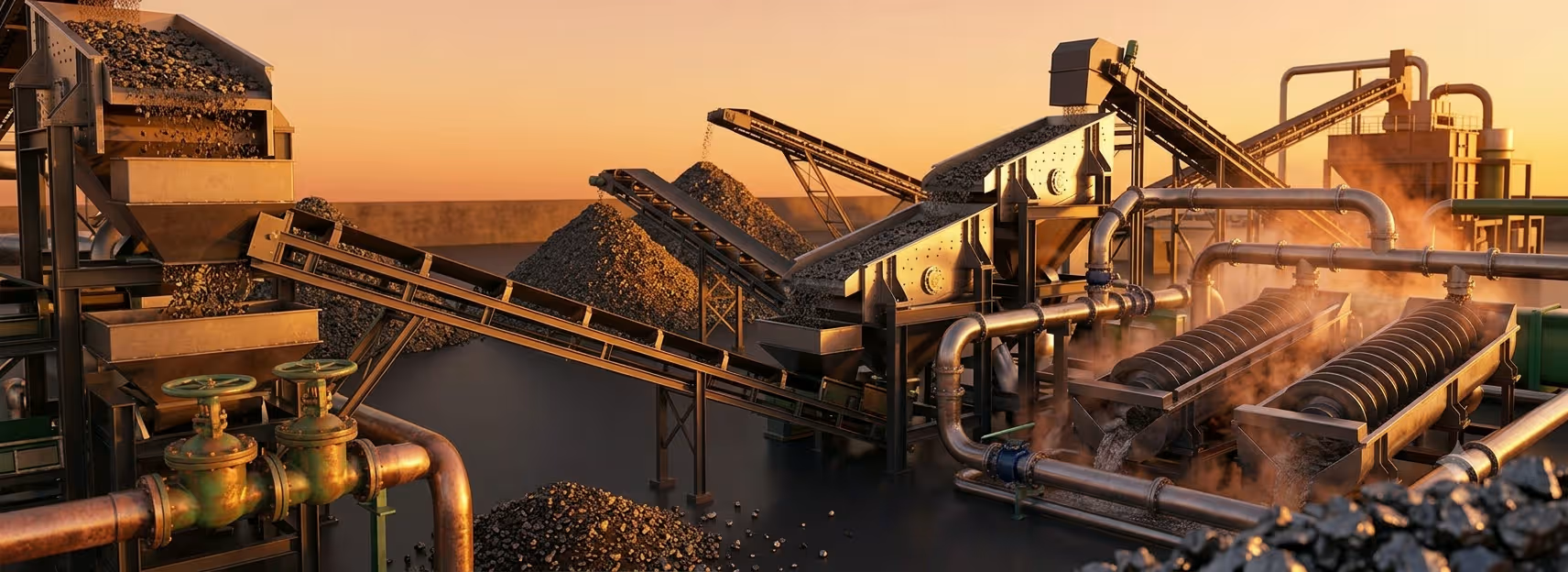
Chrome Ore Beneficiation forms the core of SMPL's mineral-processing activities. The Company processes friable and sub-grade chromite ore through wet gravity beneficiation, separating higher-density chrome-bearing mineral particles from lighter gangue material to produce marketable chrome concentrate.
Approximately 100 MT of feed per hour. This is a plant feed-processing capability and should not be confused with annual statutory throughput or permitted annual production figures - the two measure different things (an hourly processing rate versus a permitted annual output) and are not directly convertible into one another without knowing operating hours and yield.

SMPL procures chromite ore from established external mineral producers rather than operating captive chromite mines. Sources include Odisha Mining Corporation (OMC), Tata Steel Mining and Vedanta FACOR, drawing on established chromite-producing regions including Sukinda, South Kaliapani and Sukrangi.
The plant uses water and gravity, not chemicals, to upgrade the ore. In short: the ore is screened to size, oversize pieces are ground down and re-screened, everything becomes a slurry, and spiral separators sort the heavy chrome particles from the lighter waste rock. The steps below walk through this in order.
Ore arrives from the Sukinda, South Kaliapani and Sukrangi regions. It is stacked and sampled first. A chemical analysis checks its Cr2O3 content, iron, silica and Cr:Fe ratio.
This analysis decides how the spiral circuit will be set up, based on the grade the customer needs. The raw ore then enters the process through a hopper and travels by conveyor belt to the screening section.
The ore passes over a vibrating screen with a 1.5 mm mesh.
Smaller pieces (under 1.5 mm), mixed with water, become slurry and go to Sump 1.
Larger pieces (over 1.5 mm) move on to size reduction.
Size classification matters because the spiral separators downstream only work well within a narrow size range - particles that are too large behave unpredictably in the spiral's flow, so they need to be broken down first.
The oversize pieces go into a disintegrator, which breaks them down further - carefully, so they don't turn into fine, unusable slime.
The broken-down material is screened again. Anything now under 1.5 mm goes to Sump 2. Anything still over 1.5 mm goes back through the disintegrator. This loop repeats until all the material is small enough.
Sump 1 and Sump 2 both feed the same beneficiation circuit. Pumps carry their slurry up to the spiral separators, giving a steady, even flow into the next stage.
This is where the actual separation happens. As slurry flows down the spirals, heavier chrome particles drift to the inside of the spiral, and lighter waste rock drifts to the outside.
Concentrate - the upgraded chrome product, sent for finishing.
Middlings - partially upgraded material, sent back through the spirals for another pass rather than thrown away.
Tailings - the leftover waste rock, sent to the tailings pond.
The splitters are adjusted for each batch, based on the ore and the grade the customer wants.
The finished chrome concentrate is stored in the product yard, kept separate by grade, ready for dispatch.
Tailings go to the tailings pond, where the water is allowed to settle out. That settled water is then pumped back into the plant and reused - cutting down on fresh water use.
Discover the milestones, experiences, and capabilities that have shaped our growth, strengthened our expertise, and guided our commitment to responsible and sustainable industrial development.A technical-capability overview of the plant's installed processing equipment, without disclosing commercial or financial detail:
|
Equipment
|
Installed / Recorded Detail
|
|---|---|
|
Double Deck Vibrating Screen
|
1 unit; 30 TPH; 5 mm and 1.5 mm mesh; 10 HP motor |
|
Single Deck Vibrating Screen
|
1 unit; 5 TPH; 1.5 mm mesh; 3 HP motor |
|
Disintegrator
|
1 unit; 30 TPH; 80 HP motor |
|
Slurry Pumps
|
7 units; 10 HP motors |
|
Additional Slurry Pumps
|
5 units; 20 HP motors |
|
Equipment
|
Installed / Recorded Detail
|
|---|---|
|
Dewatering Pumps
|
Multiple units across 10 HP, 7.5 HP, 5 HP, 3 HP and 2 HP ratings |
|
Hopper
|
1 unit; 20 MT |
|
Conveyor
|
1 unit; 800 mm belt width; 20 metre length |
|
Generators
|
108 KVA and 63 KVA |
|
Transformer
|
1 MVA |
A separate regulatory operating profile, so annual statutory permissions are never confused with the plant's ~100 MT/hour feed-processing capability:
|
Equipment
|
Installed / Recorded Detail
|
|---|---|
|
Existing COB throughput capacity
|
18,500 TPA |
|
Permitted Chrome Concentrate production capacity
|
16,738 TPA |
|
Approved groundwater withdrawal limit
|
25 KLD |
|
Recorded actual groundwater use
|
Approximately 20–24 KLD |
|
Proposed COB capacity after expansion
|
3,60,000 TPA - proposed, not operational |

Our journey began with a simple belief — that sustainable businesses are built step by step, through hard work, trust and the courage to keep moving forward. When I entered the mineral sector in 2003 with a single six-wheeler truck engaged in mineral transportation, there was no large industrial enterprise behind us. What we had was an opportunity to learn the industry from the ground up. That experience gave us an understanding of the mineral value chain and eventually led us into chrome ore beneficiation in 2007 and, in 2010, to the establishment of Shree Monolithics at Bhandaripokhari.


Your information has been sent successfully. We will get back to you soon.